Red imported fire ants thrive in North Texas clay soils, constructing deep subterranean nests beneath turf, paving stones, and landscaping along residential properties. In established neighborhoods like Lakewood, Lake…
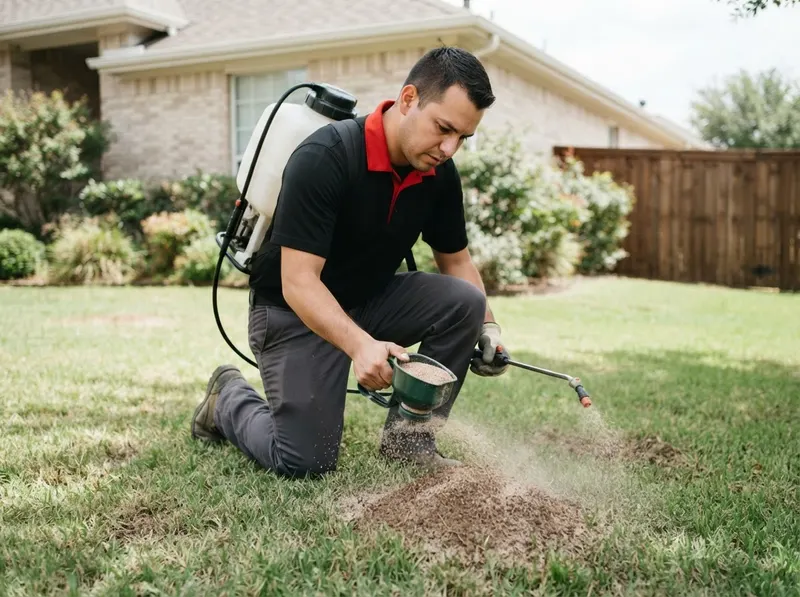
Red imported fire ants thrive in North Texas clay soils, constructing deep subterranean nests beneath turf, paving stones, and landscaping along residential properties. In established neighborhoods like Lakewood, Lake Highlands, and Preston Hollow, extensive irrigation and proximity to White Rock Lake create moisture reservoirs that drive aggressive mound production from April through October. Left unmanaged, these colonies form interconnected subterranean tunnels extending 25 feet outward, presenting physical stinging hazards to children and domestic pets. Treating only visible mounds with hardware-store powders fails because the queen relocates within hours; durable control requires an insect growth regulator (IGR) bait taken directly into the royal brood chamber combined with a residual perimeter barrier.
Property size dictates the treatment framework. Standard city lots in Oak Cliff or the Bishop Arts District with under 5,000 square feet of turf require localized mound injections and a single broadcast pass. Half-acre to one-acre properties in Far North Dallas require motorized granule spreaders to distribute granular baits evenly at calibrated label rates (typically 1.5 pounds per acre). The operational trade-off centers on application speed versus foraging behavior: broadcast baits demand 48 hours of dry conditions without sprinkler activation to maintain palatability, whereas liquid contact barriers establish immediate exterior defenses against foraging worker scouts entering patios near Deep Ellum and Uptown townhomes.
Work follows a three-step protocol on the service day: 1. A licensed Texas Department of Agriculture (TDA) applicator maps active colonies and identifies electrical conduits, wellheads, or drainage zones. 2. Granular bait formulated with hydramethylnon or methoprene is distributed across the entire yard perimeter so worker ants deliver the active agent down to the queen. 3. Active visible mounds receive low-pressure liquid drenches using EPA-registered pyrethroids or fipronil, neutralizing stinging field workers while the deeper brood chamber collapses over subsequent days. Standard single-service applications are available without forcing homeowners into expensive recurring contracts.
Every job gets a firm, written price after a free on-site visit.
Tell us about your fire ant yard defense job in Dallas and we'll send a clear, written quote, usually the same day.
 Red Wagon Pest Control