Subterranean termites nest underground and rely on soil moisture to survive, building mud exploration tubes over concrete foundations to reach framing lumber, subflooring, and sheetrock paper. In historic pier-and-beam…
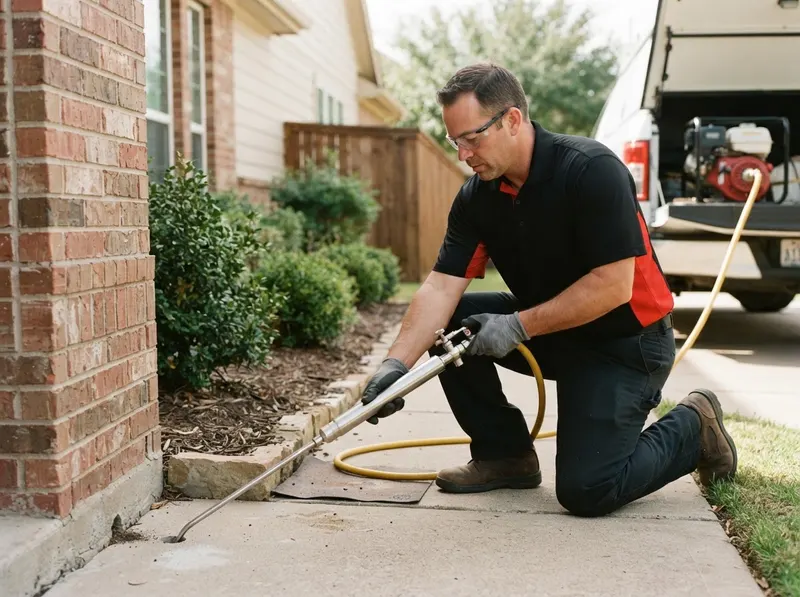
Subterranean termites nest underground and rely on soil moisture to survive, building mud exploration tubes over concrete foundations to reach framing lumber, subflooring, and sheetrock paper. In historic pier-and-beam cottages across Oak Cliff and Lakewood, treatment requires technicians to crawl the subfloor to trench soil along interior grade beams and masonry piers. For modern slab-on-grade homes in Preston Hollow and Far North Dallas, technicians excavate a 6-inch by 6-inch trench around the exterior perimeter, apply non-repellent liquid termiticide at four gallons per ten linear feet, and backfill the treated soil to establish a continuous protective barrier. Properties surrounding the Dallas Arboretum and Botanical Garden or White Rock Lake contain higher ambient soil moisture, which often accelerates foraging activity against slab expansion joints and plumbing penetrations.
Property owners choose between perimeter liquid chemical barriers and slow-acting termite baiting systems. A non-repellent liquid treatment like fipronil bonds directly to clay soil particles and works through contact transfer, eradicating foraging workers and the central queen within 60 to 90 days. Conversely, an exterior baiting system places monitoring stations every ten to fifteen feet along the drip line, utilizing a chitin synthesis inhibitor that worker termites carry back to the colony. Liquid barriers provide faster perimeter defense during active swarms, while bait systems eliminate the need to drill through finished flagstone patios, pool decks, or tile entryways common in Uptown and Lake Highlands residences.
Subterranean termite treatment requires distinct approaches compared to drywood termite fumigation. Subterranean species nest in native ground soil and require soil-level contact or monitored ingestion, whereas drywood termites live entirely inside dry structural wood without soil contact. Homeowners facing swarming insects along baseboards benefit from verifiable physical measurements: structural damage typically occurs when moisture issues, such as misdirected sprinkler heads or faulty roof runoff near Bishop Arts District bungalows, create softened wood near ground grade. Standard localized trenching stops foraging lanes, but structural integrity restoration remains a separate carpentry process once insect activity ceases.
Every job gets a firm, written price after a free on-site visit.
Tell us about your subterranean termite treatment job in Dallas and we'll send a clear, written quote, usually the same day.
 Red Wagon Pest Control